Music Therapy & Education for Deaf & Hard of Hearing Children
Spokane HOPE’s music program for deaf and hard-of-hearing children turns every note into a language learning experience, helping them build vocabulary, rhythm, and communication skills through music. Through engaging songs, rhythms and movement, children build vocabulary, communication skills, and early literacy foundations – all while having fun!
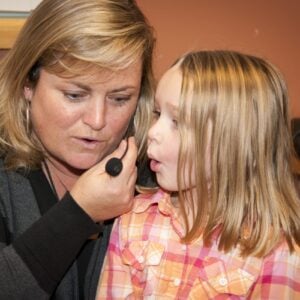
Each week, our preschoolers participate in a 30–45 minute adapted music session led by a music specialist and supported by a Teacher of the Deaf or Speech-Language Pathologist. These sessions incorporate singing, rhythmic movement, instrument play, listening games, and vibration or tactile elements that help make musical patterns meaningful and accessible for every child.
Families in our toddler program are also invited to join their child for a weekly music group filled with movement, connection, and fun. Parents receive weekly coaching and take-home materials to help them weave music into everyday routines—turning songs, rhythm, and play into powerful tools for language development at home.
Why Spokane HOPE’s Music Program is essential for deaf and hard of hearing children
Research links structured music therapy for deaf students to stronger speech-in-noise perception, sharper phonological awareness, and richer social-emotional growth.[1][2]
All activities are acoustically optimized and paced for small groups, so that every child, device user or not, can feel the beat, sign, sing, or drum along.
Sources:
Rochette, F., et al. (2014). Music lessons improve auditory perceptual and cognitive performance in deaf children. Frontiers in Human Neuroscience, 8, 488. Link.
Good, A., et al. (2017). Benefits of music training for perception of emotional speech prosody in deaf children with cochlear implants. Ear and Hearing, 38(4), 455-464. Link.
“One of the greatest joys of our lives...
“Our child has not only learned to communicate—they have found their voice. They are confident, curious, joyful, and proud of who they are. Watching them verbally speak with friends, express themselves in the classroom, and build real relationships has been one of the greatest joys of our lives.”
The Impact of Spokane HOPE’s Music Program
Spokane HOPE integrates music into our program for children who are Deaf and Hard of Hearing to ensure that our students have rich, engaging opportunities to explore rhythm, sound, and movement. The known benefits of our music program include, but are not limited to:
The benefits:
Improved Speech Clarity
Drumbeats and melody lines mirror the prosody of natural speech. Tapping to a steady beat or chanting “ba-ba-BA!” helps children feel the stress on syllables, making their own words clearer and easier to understand. (ScienceDirect)
Enhanced Auditory Memory
Catchy tunes and weekly rhymes embed sounds in the brain. Repetition through song strengthens the mental “holding tank” kids need to follow directions, learn new words, and read. (PMC)
Social Turn-Taking
Passing a shaker or echoing a friend’s melody teaches wait–listen–respond—the rhythm of conversation. These musical turn-taking games nurture peer interaction and confident self-expression in and out of class.
Set Your Preschooler Up to Listen, Speak & Shine
To learn more about enrolling your child who is deaf or hard-of-hearing into our LSL specialized programs, let’s talk. Simply fill out this contact form to get in touch with our program director or request to schedule a tour of our facility to see what makes us different from other programs.